Pesticides Presence in the Environment
What are Pesticides?
Pesticides are products used to control pests on plants and animals. They include chemical or biological agents used in agriculture, forestry, and non-agricultural public areas to manage and suppress plant pathogens and diseases, insects, nematodes, mites, harmful rodents, weeds, and other pests. Pesticides are classified based on their target groups: herbicides, insecticides, rodenticides, fungicides, etc.
History of Pesticide Development
The use of pesticides dates back to ancient Romans, who used sulfur to repel pests and salt and ash to control weeds. In the 1600s, a mixture of honey and arsenic was used to combat ants. A significant increase in pesticide use occurred during World War II when effective and inexpensive pesticides like DDT were developed. The use of DDT expanded significantly due to its strong effect at low doses. After the ban on DDT in 1972 in the United States, restrictions on the use of endosulfan, dieldrin, and lindane followed.
The Stockholm Convention
In 2001, 179 countries signed the Stockholm Convention, an international treaty aimed at the complete ban of 12 persistent organic pollutants (POPs) (aldrin, chlordane, DDT, dieldrin, eldrin, heptachlor, hexachlorobenzene, mirex, and toxaphene, PCBs, HCB, PCDD/PCDF). The Stockholm Convention came into force in 2004. Following this, numerous restrictions and bans on pesticide use were implemented. POPs encompass a wide range of toxic organic compounds with properties such as toxicity, persistence (resistance to chemical, photochemical, and biological degradation), bioaccumulation, potential for long-range transport, and impact on the environment and human health, particularly affecting women and future generations.
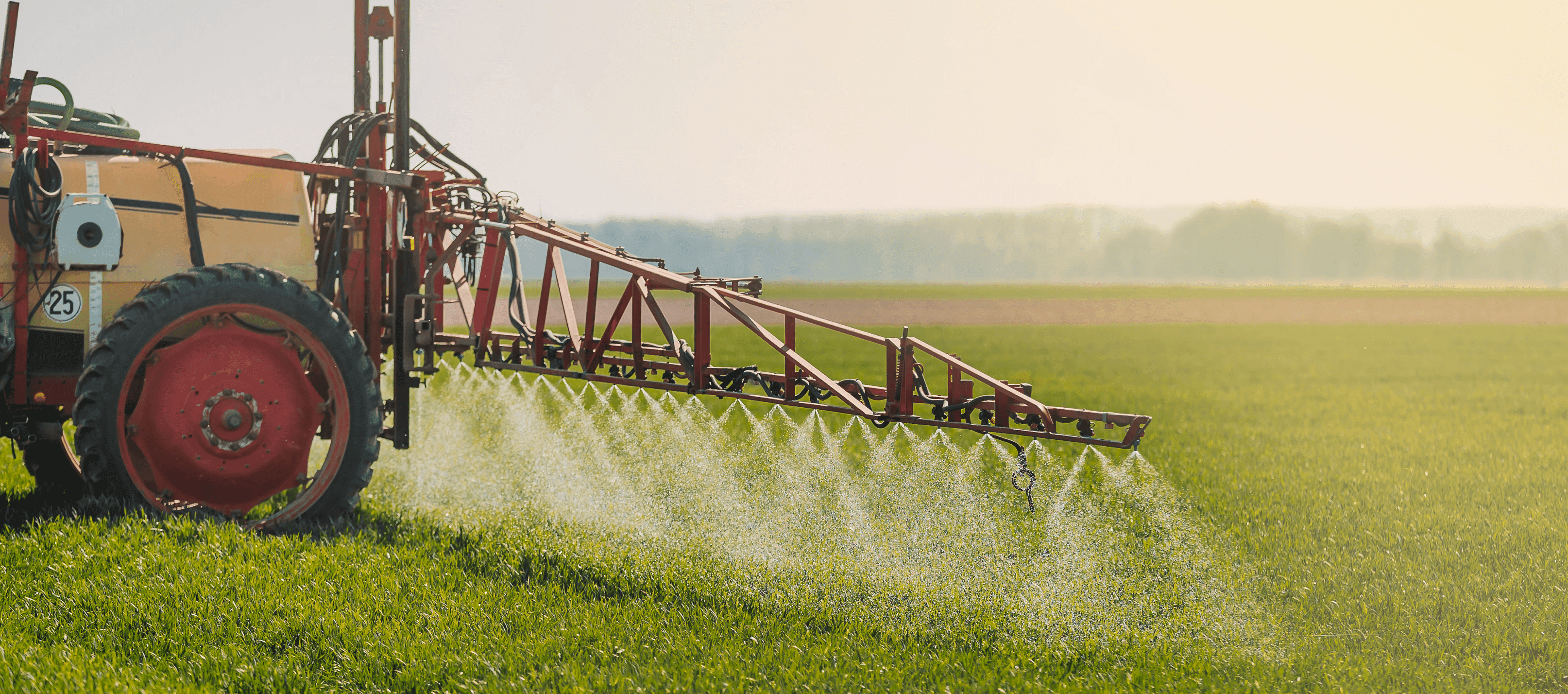
Image 1. Treating crops with pesticides
Presence of Pesticides in the Environment
The ubiquitous problem of pesticides in the environment raises concerns due to bioaccumulation, which poses risks to humans. Initially low concentrations of pesticides accumulated in water and soil can increase through the food chain to organisms used in human consumption. Pesticides enter water bodies through runoff from agricultural lands, industrial wastewater, or directly. Water-soluble pesticides are washed through soil layers during precipitation, ending up in surface and groundwater, leading to reduced water quality and affecting the supply of clean drinking water.
Monitoring, regulation, and setting threshold values are implemented through legal frameworks to track pesticide residue concentrations in the environment. The Regulation on the Limit Values of Wastewater Emissions (NN 26/2020), Regulation on Compliance Parameters, Analysis Methods, and Monitoring of Water for Human Consumption (NN 64/2023), and Regulation on Water Quality Standards (NN 96/2019) stipulate the maximum allowable amounts of pesticide residues in aquatic environments. The Regulation on Protecting Agricultural Land from Pollution (NN 71/2019), Regulation on Methodology for Monitoring Agricultural Land (NN 47/2019), and others establish threshold values for pesticides in soil.
Presence of Pesticides in Food and Animal Feed
All food products intended for human consumption or as animal feed in the European Union (EU) are subject to monitoring for maximum residue levels of pesticides to protect human and animal health. The maximum permissible threshold values are specified in Regulation 396/2005 on maximum residue levels of pesticides in or on food and feed of plant and animal origin and Directive 2002/32/EC on undesirable substances in animal feed.
Pesticide Analysis at Sample Control
Sample Control d.o.o. is a leading laboratory in the region for analytical testing, specializing in pesticide testing. Using modern techniques such as LC Orbitrap HRAM, GC Orbitrap HRAM, and GC-MS/MS, the laboratory offers comprehensive analysis of pesticide residue testing in the environment, food, and animal feed, ensuring high precision and reliability of results. Given the known persistence and toxicity of persistent organic pollutants (POPs) in the environment, Sample Control d.o.o. provides analysis to determine the baseline (initial) state of the environment in soil and water, allowing for the identification of potential contamination.
With advanced analytical methods, Sample Control enables rapid result delivery, which is crucial for making right decisions.